
2013 Review: Integrated Weed Management
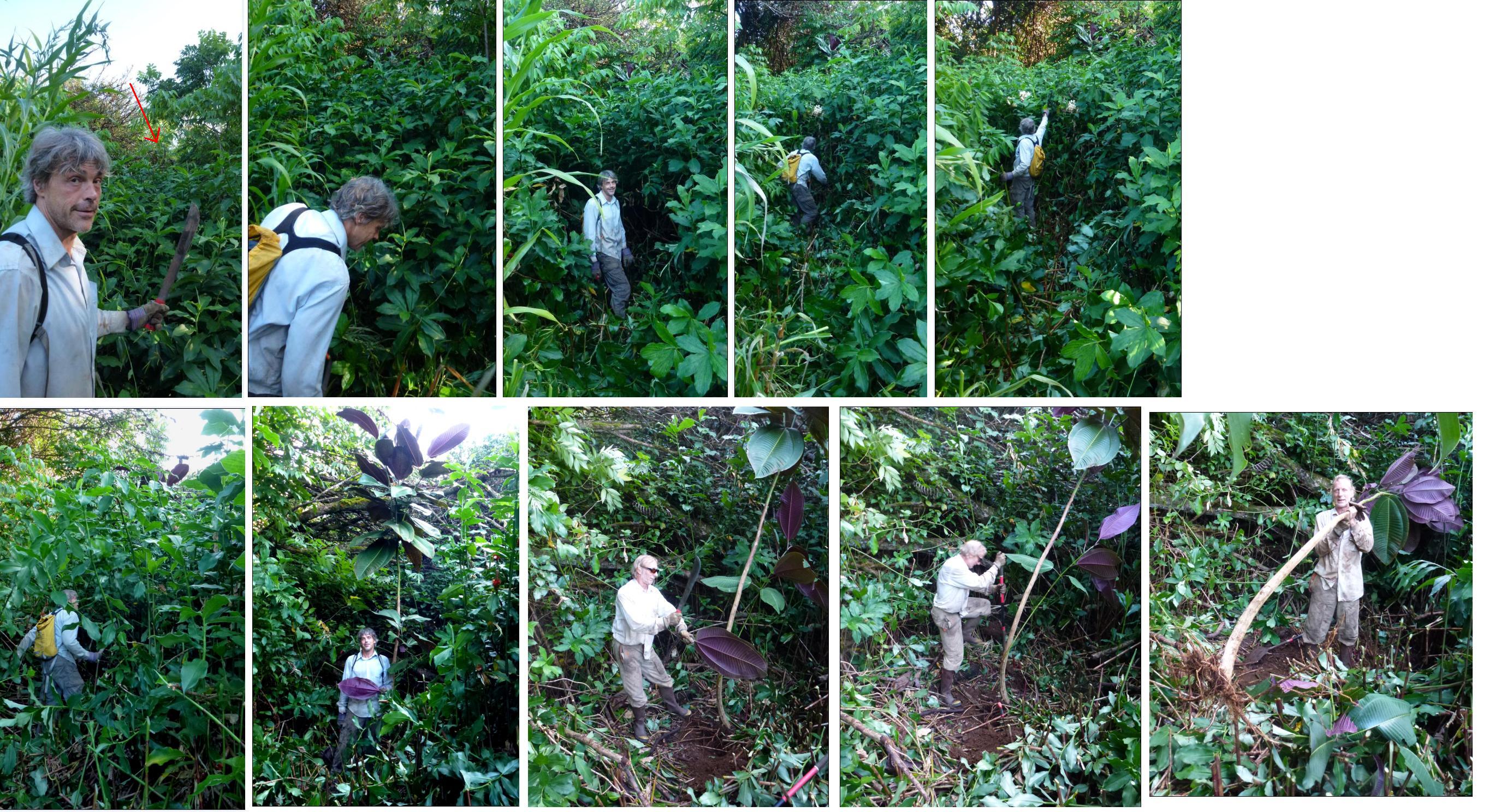
Hunting the Killer Miconia
Organic agriculture is our preferred approach to building our farm, and we always attempt to use organic (read: hard labor) methods to reduce the impact of invasive weeds. By “weed” we usually mean shrub and tree weeds such as Clidemia (Koster’s curse), African Tulip Trees, Strawberry Guava and Inkberry. However, if we really want to foster the long term sustainability of the farm, we have to sometimes bring out the big guns. You’ve never seen a weed grow until you’ve watched a Tulip Tree: cut it down and the stump will grow a bunch of 2-3″ diameter, 10-20′ tall shoots in a matter of months. Keep cutting it down and trimming the shoots and you’ll get shoots that sprout off the roots. Nonetheless, we’re still fighting these guys using manual methods. Our most earth-friendly alternative is to inject the tree with Roundup which we still have not used.
Luckily, Miconia is a rare find on our property. The pic above shows us removing a monster Miconia that was growing within 50 feet of the house, hidden until it peeked above the 20′ tall ginger and Job’s Tears. We immediately got the tools and dug it out, trying to get all the roots. If you leave any of these invasives touching the ground, they will reroot, so we hung it next to the road to proudly display our victim to the neighbors and called the Maui Invasive Species Commission (MISC) who searched the property for more.
Removing countless Strawberry Guava gave us lots of quick burning firewood so we could start Dutch Oven cooking and reduce our dependence on propane. We take pleasure in the simple things around here. The weeds take pleasure in repeatedly coming back!
All this hard work took a toll on our bodies. An initial slowdown after Thanksgiving soon turned into a prolonged slowdown due to the lingering affects of overwork and repetitive stress. Our hands suffered in particular, but the arms weren’t off the hook either. After about six weeks, we feel like we’re ready to start anew.

Before you use Roundup, you might try using acid instead. I suspect almost any acid would do, I am somewhat familiar with muriatic (pool acid) and sulfuric (I think plumbers use this to clear some drains). You may need to drill some holes in the trunk to ensure the acid gets absorbed into the roots. I suspect (although I am not quite sure) that this is more environmentally friendly compared to roundup, since the interaction with the wood will tend to dilute the acid, and rains will further dilute it. Alan
Thanks for the tip Alan. We’ve not heard of using muriatic, nor sulfuric acid, but sea salt is supposed to be somewhat helpful. We’re still holding off on actually using Roundup, although we now own a gallon. I’ve always been against Roundup, etc., but it decomposes in days to carbon dioxide, water and nitrates so by drilling it into the trunks we pretty much assure that nothing toxic will get into the environment (other than nitrates which are in much of our food). Nonetheless, I’m still resisting using it. I’m likely to give in, due to the extremely virulent strawberry guava and African tulip trees, along with the knowledge that most of the purists who resist Roundup have no problem using plastic-like products daily despite the vast array of toxic, carcinogenic compounds that are used in their production, and arise from their decomposition. Another inconvenient truth.